What’s Your Type
A web-based survey for the Computational Creativity Lab to assess the sentiments associated with open-source web fonts.
Overview & Challenge
Open-source fonts are ubiquitous on the Web, and yet we understand very little about the implicit connotations and underlying perceptions that users have of them. Nor do we understand how these perceptions vary across cultures and languages. What’s Your Type seeks to understand these font connotations and perceptions through a web-based survey.
The survey asks users to pick the font that best matches an emotive adjective—including “playful,” “informative,” and “trendy.” By gathering user responses, What’s Your Type crowdsources a database of font preferences, searchable by language and nationality of the respondent.
Design
A short promotional video for What’s Your Type and communicate the survey’s purpose: understanding the implicit connotations of open-source web fonts.
Before beginning, a brief popup explains the structure and purpose of the survey. We found that written instructions as well as a short animation helped prevent confusion once users began the survey.
An example of a survey question. Users are asked to pick the font that best matches an emotive adjective like “quirky.” Background gradients for each keyword help users easily distinguish the questions from one another.
The mobile layout, changing the card layout to ensure legibility of the typeface options and moving the survey progress to stretch across the bottom of the screen.
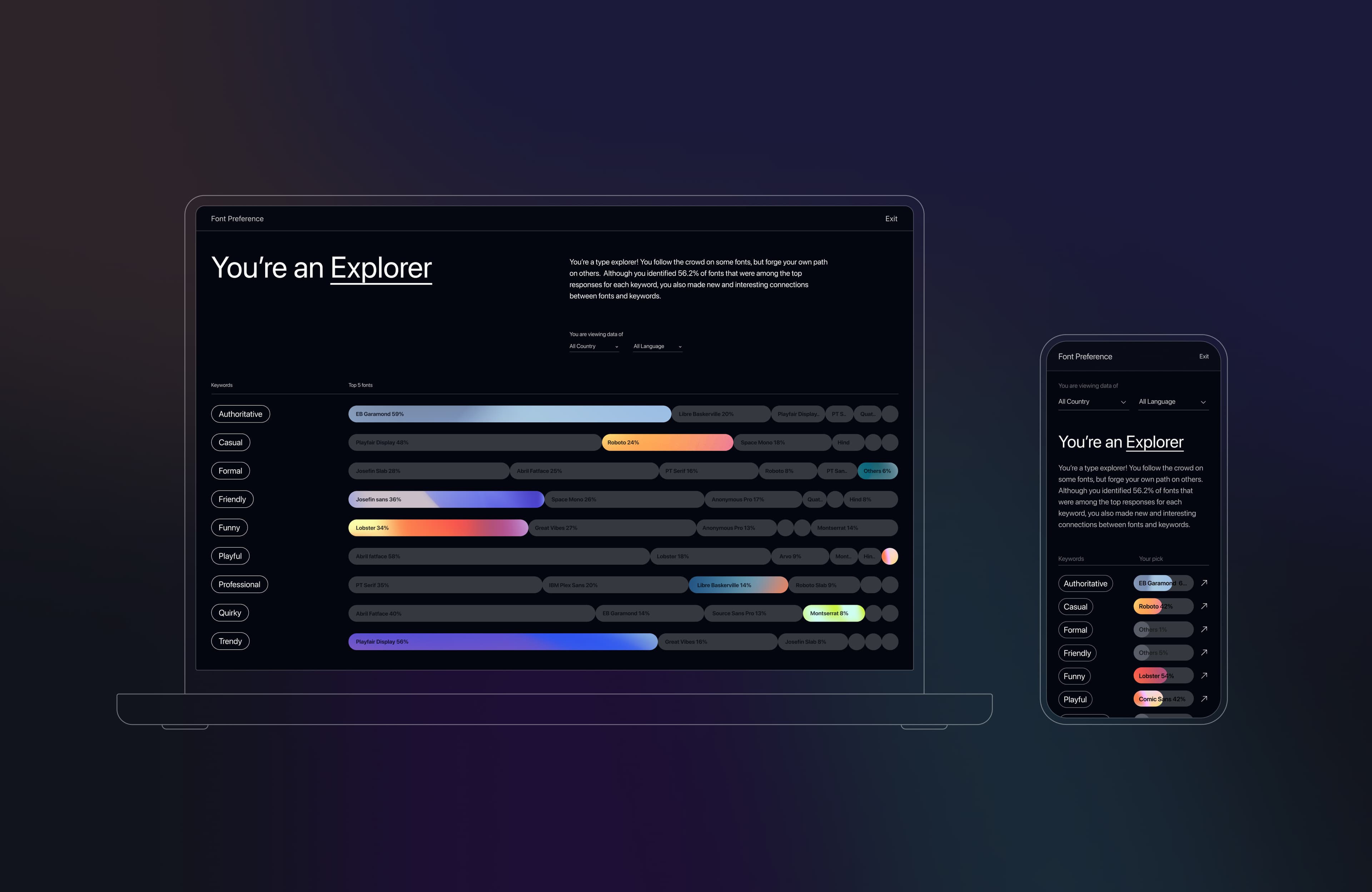
After completing the survey, users can see how they’re choices compared with other respondents. Did they associate typefaces with the same adjectives as other users? Users can filter results by the nationality and language of the respondent to get a sense of how typeface preferences vary.
In addition to the final UI mockups and survey logic, final design deliverables included a set of annotated screens to communicate interactions patterns to the development team.
Building the survey with Cursor
We completed the design in the spring of 2022, but ran into an all too common problem—we didn’t have the resources or expertise to complete development. The semester ended, some of the team graduated, and the Figma file sat unused. An unrealized project.
Four years later and the world of software development and design has changed. AI coding agents have changed what’s possible for someone without a software engineering background like myself. And in an effort to explore these tools, I built the survey using Cursor.
Impact
This project was funded with an initial seed grant from the Frank-Ratchye Studio for Creative Inquiry at Carnegie Mellon University. At the conclusion of the design phase, final design materials were presented to lab and university leaders, who were thrilled with the idea of creating a database of font preferences across the globe and the fidelity of the final designs.
Unfortunately, graduation timelines conflicted with our plans and we lost our in-house engineering resources before we could complete a build. The project stalled after the semester ended, and we were not able to truly test our cross-cultural typeface hypothesis.
Takeaways
New pathways for ownership
This project sat unbuilt for four years. Returning to it was an exciting way to explore how much of the end-to-end experience a designer can now own without an engineering handoff. In the traditional design-development workflow, the last 10% of design polish–max-width behavior, scroll states on the results tooltip, precise breakpoints–is easy to lose between design and development. Having direct control over that layer meant the shipped experience matched the intent, and let me stress-test the design myself rather than relying on a developer to catch what I meant.
The project’s original hypothesis, that font perception varies by culture and geography, is still untested since no responses have been collected yet. The next step is partnering with the Studio for Creative Inquiry to recruit respondents and reach a sample large enough to actually answer it.